

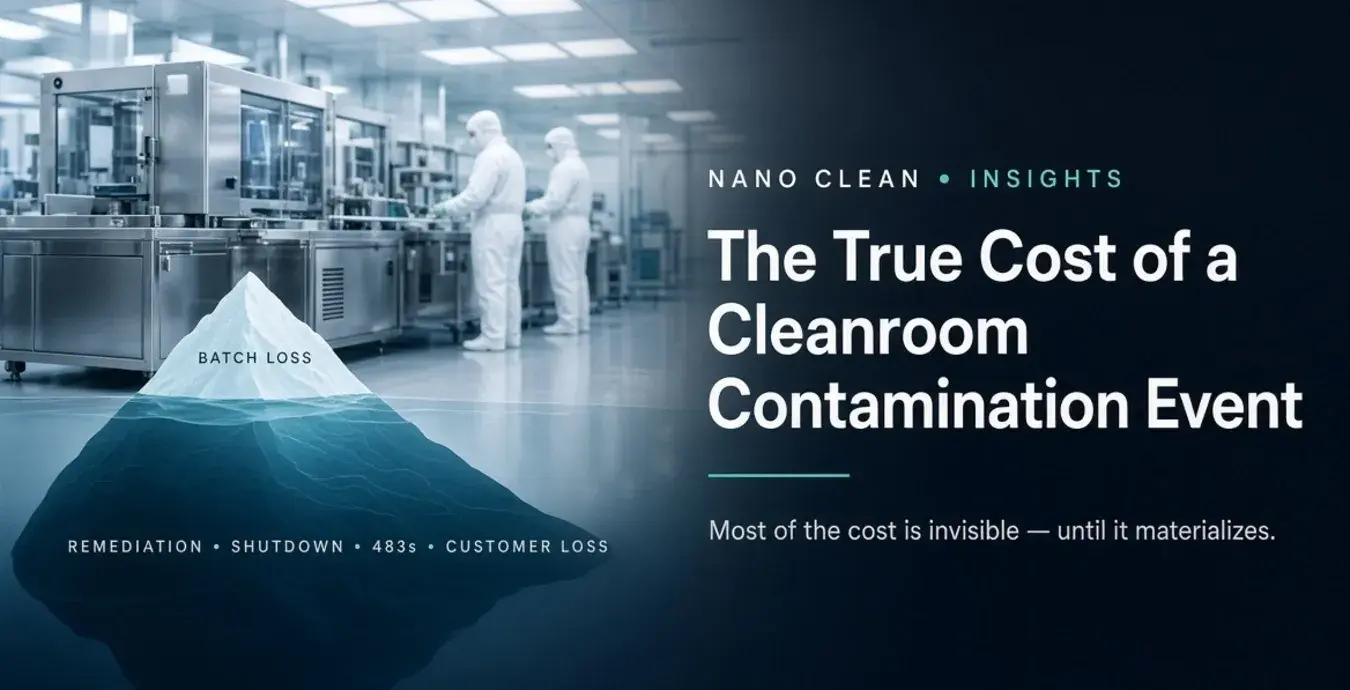
Understanding the full scope of contamination event costs is central to evaluating how much a GMP cleanroom cleaning program is actually worth. The arithmetic, when done honestly, is rarely close.
Direct Costs: What You Can Count Immediately
The most visible component of a contamination event is the immediate financial hit from compromised product. In pharmaceutical manufacturing, a single contaminated batch may represent weeks of manufacturing activity and hundreds of thousands to millions of dollars in raw materials, processing labor, and overhead. In a hospital or compounding pharmacy setting under USP Chapter 797, contaminated compounded sterile preparations must be identified, quarantined, and in many cases recalled — with all the associated downstream disruption to patient care and formulary availability.
Beyond the batch itself, the direct cost structure includes:
- Remediation cleaning: A contamination event does not resolve with routine cleaning. Remediation typically involves intensified decontamination cycles — often using vaporized hydrogen peroxide, chlorine dioxide fogging, or other sporicidal agents — across the affected and potentially affected areas. This is a specialist activity with its own cost, disruption to the production schedule, and documentation requirements.
- Enhanced environmental monitoring: Following a contamination event, regulatory expectations under FDA 21 CFR Part 211 and ISO 14644-2 require increased EM sampling frequency until the environment is demonstrated to be back in control. This accelerates the EM consumables budget and requires additional analytical processing and reporting.
- Investigation labor: Root cause analysis for a contamination event is not a quick exercise. QA directors, microbiologists, and cleaning program supervisors will spend significant hours reconstructing the timeline, reviewing documentation, sampling additional surfaces, and writing investigation reports. At fully loaded labor rates, this is rarely a minor line item.
Indirect Costs: The Multiplier That Makes the Real Number
Direct costs are quantifiable. The indirect costs are where contamination events become genuinely damaging — because they operate over a longer time horizon and affect areas of the business well beyond the quality department.
Production Shutdown and Schedule Recovery
A contamination event in a sterile manufacturing suite or aseptic compounding cleanroom often requires a production hold while investigation and remediation are completed. For a manufacturer with contracted supply commitments, this is not just lost revenue from the contaminated batch — it is a supply chain disruption that affects customers, requires expedited communications, and may trigger contractual penalties. In hospital pharmacy settings, a production hold can directly affect patient care if critical preparations are unavailable and alternative sources must be identified rapidly.
Regulatory Consequences and Inspection History
A documented contamination event becomes part of your facility's regulatory record. Under FDA's inspection regime, a history of EM excursions, contamination events, and associated CAPAs informs the depth and frequency of future inspections. A facility with documented contamination control issues is more likely to receive an unannounced inspection, face a more intensive review during routine inspection, and receive observations that reference prior history. FDA 483 observations citing inadequate environmental controls are cumulative — a pattern of environmental excursions followed by inadequate corrective action is exactly the kind of trajectory that produces Warning Letters.
For facilities operating under EU GMP Annex 1, the parallel consequences apply: contamination events trigger scrutiny that does not dissipate quickly and that affects the facility's standing with its Qualified Person and regulatory authority.
Customer and Partner Confidence
For contract manufacturers, CDMOs, and contract compounding facilities, a contamination event is a customer relationship risk. Clients who discover — through audit findings, regulatory communications, or supply disruption — that their products were manufactured in an environment with documented contamination issues may trigger their own investigation, issue a SCAR, or elect to qualify an alternative supplier. Rebuilding customer confidence after a contamination event is a multi-month process, and some clients do not return.
The connection to environmental monitoring failures driven by inadequate cleaning is direct: most contamination events that reach regulatory or customer visibility have detectable precursors in the EM data — rising trends, location-specific excursions, organism profile shifts — that were not acted upon because the connection between EM signals and cleaning program gaps was not clearly drawn.
The Cost in Practice: New England Compounding Center
Everything above is a model. New England Compounding Center is what the model looks like when it resolves, and it happened in this region.
In 2012, NECC, a compounding pharmacy in Framingham, Massachusetts, shipped preservative-free methylprednisolone acetate contaminated with environmental mold, primarily Exserohilum rostratum. The CDC identified 753 patients across 20 states with fungal infections traced to those injections. More than 100 of them died. It is the largest public health crisis in United States history caused by a contaminated pharmaceutical product.
The FDA's Form 483 did not describe an exotic failure mode. It described cleanroom control and cleaning execution problems that any QA director would recognize from a routine audit:
- Environmental control was suspended nightly. Air conditioning in Clean Room 1 was shut off from 8:00 p.m. to 5:30 a.m., leaving temperature and humidity uncontrolled for more than nine hours a day.
- The air intake was compromised by siting. The rooftop HVAC units sat roughly 100 feet from a recycling facility that generated heavy airborne particulate.
- Contamination was visible to inspectors. Investigators observed greenish-black matter and yellow discoloration on cleanroom surfaces and processing equipment.
- The EM data had already flagged it. NECC's own monitoring found bacteria and mold in multiple cleanroom locations between January and September 2012, some of it above the facility's own action limits. FDA found no record of corrective action.
That last item is the one to sit with if you have your own EM binder in mind. The signal was in the facility's own records for nine months. Federal prosecutors later established that NECC's supervisory pharmacist ran production ahead of cleaning, directed staff to forge cleaning logs, and disregarded the mold and bacteria found inside the clean rooms.
The Total Cost
NECC stopped operating and filed for Chapter 11, with roughly $200 million set aside in a victim settlement fund. Massachusetts moved to revoke the pharmacy license within weeks. The co-owner and head pharmacist was convicted of racketeering and mail fraud and, after resentencing in 2021, is serving 14 and a half years with $82 million in restitution ordered. The supervisory pharmacist received 10 and a half years. Congress responded with the Drug Quality and Security Act of 2013. Every 503B outsourcing facility in the country now operates under a framework written because one pharmacy could not control its cleanroom.
What the Case Does and Does Not Show
NECC was criminal conduct supported by falsified records. No legitimately run facility is one bad quarter away from that outcome, and reading the case as a warning about ordinary programs gets it wrong.
What transfers is the mechanism. The organisms were environmental. The contamination was preventable by cleaning. The warning appeared in routine EM data long before anyone outside the building knew there was a problem. Most facilities see excursions. The difference is what happens in the ninety days after one appears.
Most contamination events are preventable. nanoCLEAN's GMP cleaning specialists have worked with pharmaceutical, biotech, and hospital pharmacy facilities for over 30 years to implement programs that hold up under regulatory scrutiny — and keep EM trends moving in the right direction.
Request a Cleanroom AssessmentThe Prevention Arithmetic: Investing in aCleaning Program
Operations and finance leaders in regulated facilities frequently apply cost pressure to cleaning programs — asking whether the current vendor is the most economical option, whether frequency can be reduced, whether the level of documentation being maintained is truly necessary. These are reasonable questions in isolation. They look different when set against the actual cost structure of a contamination event.
Consider the cost components of a moderate contamination event in a pharmaceutical manufacturing setting: one contaminated batch, one two-week production hold for investigation and remediation, one full remediation decontamination cycle, enhanced EM sampling for 90 days, 400 hours of QA and management investigation labor, and one FDA 483 observation requiring a written response. Conservative estimates for each line item, at reasonable industry rates, produce a total that almost invariably exceeds the annualized cost of a properly managed specialized cleaning program by a substantial multiple.
The question is not whether the cleaning program is an expense — it is. The question is whether the expense of a qualified program is proportionate to the risk it manages. For facilities operating under FDA 21 CFR Part 211, USP Chapter 797, or EU GMP Annex 1, the regulatory framework already answers that question: cleaning is a GMP-required activity, and its quality must be maintained and documented. The commercial logic simply reinforces what the regulatory framework already mandates.
The Role of the Cleaning Vendor in Contamination Risk
A cleaning contractor who enters a controlled environment without proper GMP training, uses non-validated disinfectants, and produces no audit-ready annual training documentation that does not reduce contamination risk — they introduce it. The cleaning contractor is a GMP-relevant supplier under FDA expectations, and their performance is your compliance responsibility.
The evaluation of a cleaning vendor should incorporate this risk calculus. The questions to ask before contracting with a cleaning service — Annual GMP training documentation, disinfection training program design, onboarding training strategy— are examined in detail in evaluating a cleanroom cleaning vendor. A vendor who can demonstrate all of these elements is not interchangeable with one who cannot, regardless of what the contract line item says.
What a Contamination-Prevention-Oriented Cleaning Program Looks Like
nanoCLEAN was founded on the principle that cleanroom cleaning is a technical discipline — not a commodity service. In 31 years of work across pharmaceutical, biotech, and hospital pharmacy facilities throughout New England, the pattern is consistent: the facilities that maintain strong EM records are the ones that treat cleaning as an integrated part of their contamination control strategy, not a support function that operates in isolation from the quality system.
What that looks like operationally: cleaning SOPs written to your facility's document control standards, disinfection programs with validated rotation schedules and sporicide integration, technicians trained and verified to your ISO classification's gowning requirements, batch records that correlate directly with your EM sampling schedule, and a service relationship where anomalies are communicated to your QA team rather than quietly noted in a log.
The contamination events we have seen at facilities transitioning to a specialized program are almost always traced to the same foundational gaps — gaps that a qualified cleaning partner identifies and closes before the EM data documents their consequences.
A cleanroom assessment with nanoCLEAN identifies specific cleaning program gaps against your facility's EM history and regulatory requirements — before an auditor identifies them for you.
Request a Cleanroom AssessmentFrequently Asked Questions
How much does a cleanroom contamination event cost?
Direct batch loss is typically the smallest component of the total cost. A contamination event in a pharmaceutical manufacturing or sterile compounding environment includes: the contaminated batch value, remediation decontamination costs, enhanced environmental monitoring for the recovery period, QA investigation labor, production shutdown impact, regulatory response preparation, and potential customer or partner relationship damage. The total routinely exceeds the direct batch loss by a factor of three to ten or more, and for a major event with regulatory consequences — FDA Warning Letter, consent decree, client SCAR — the financial impact extends across multiple fiscal years.
What are the regulatory consequences of a cleanroom contamination event?
For FDA-regulated pharmaceutical manufacturers under 21 CFR Part 211, contamination events may produce 483 observations, Warning Letters, or consent decrees depending on severity and systemic pattern. They become part of the facility's inspection history and influence the depth of future FDA reviews. For USP 797 compounding pharmacies, consequences may include state board of pharmacy sanctions and mandatory remediation before resuming sterile compounding. In all regulated environments, a documented contamination event is a record that persists and affects the facility's regulatory standing in future interactions.
What is the most common cause of contamination events in pharmaceutical cleanrooms?
Personnel are the leading source, accounting for the majority of viable contamination events across the industry. Cleaning personnel are specifically included in this risk category when they are not properly trained, gowned, or executing GMP-compliant cleaning technique. After personnel, inadequate cleaning and disinfection — including absence of sporicide rotation, incorrect contact time, and technique errors — are among the most common root causes identified in EM excursion investigations and FDA observations related to environmental controls.
How do you prevent cleanroom contamination events?
Contamination prevention requires a layered program: validated disinfection with documented rotation and sporicide inclusion, SOPs written to execution-level specificity, training verified through performance observation, tools and materials qualified for the ISO classification, and systematic EM trend analysis to detect cleaning program drift before it produces excursions. The most preventable contamination events are those preceded by detectable EM signals — rising trends, location-specific excursions, organism profile shifts — that were not connected to cleaning program gaps and acted upon in time.