

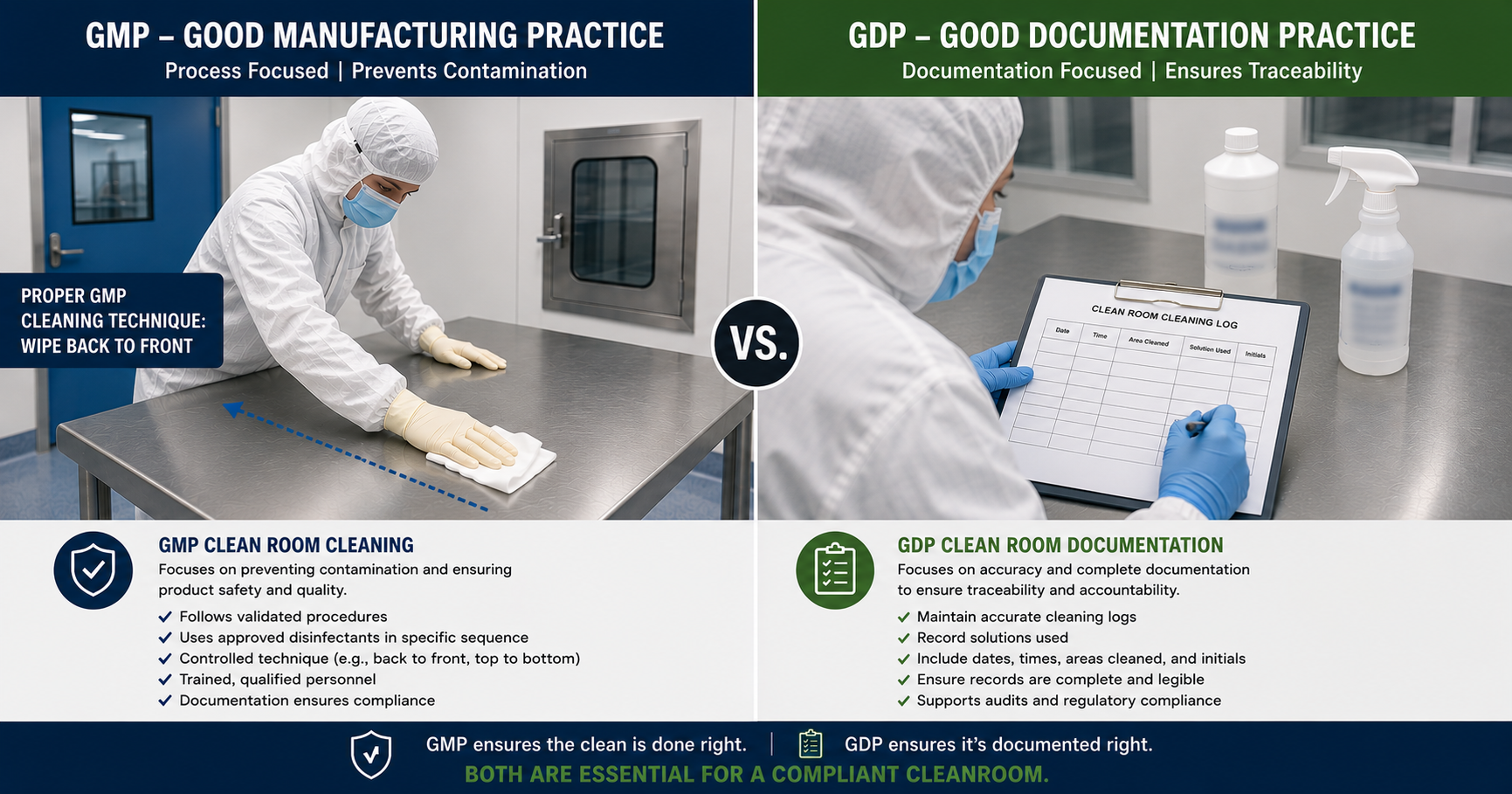
GMP — Good Manufacturing Practice — governs what you do. GDP — Good Documentation Practice — governs how you record it. Both are required by FDA 21 CFR Part 211. A facility can execute technically correct cleaning procedures and still fail a GDP audit. It can maintain pristine cleaning records of an inadequate cleaning program and fail GMP. The two frameworks are simultaneously active and independently enforceable.
What GMP Governs in Cleanroom Cleaning
GMP requirements in cleanroom cleaning address the substance of the cleaning program: what gets cleaned, with what materials, by whom, using which procedures, and at what frequency. Under FDA 21 CFR Part 211 — specifically Subpart D (Equipment) and Subpart E (Control of Components and Drug Product Containers and Closures), as well as 211.67 (Equipment cleaning and maintenance) — facilities must maintain written procedures for cleaning and sanitation of equipment and the facility itself.
Concretely, GMP requirements drive the following elements of a cleanroom cleaning program:
Written, controlled SOPs. Every cleaning procedure must exist as a written, approved document. Unwritten procedures do not exist in a GMP context — if it is not documented, it cannot be demonstrated to have occurred correctly. SOPs must be version-controlled, reviewed on a defined schedule, and updated whenever the procedure changes.
Validated or qualified cleaning agents. Disinfectants used in GMP cleanrooms must be EPA-registered for the intended use. Their efficacy must be demonstrated against the organism spectrum of concern in the classified space. This means sporicidal agents for periodic deep decontamination in areas where endospore-forming organisms are a risk, bactericidal and fungicidal agents for routine use, and a rotation protocol that prevents selective resistance development. Contact time is part of the GMP requirement — using the right product at the wrong dwell time does not achieve the kill claim.
Qualified personnel. GMP requires that personnel performing regulated activities — including cleaning — have the education, training, and experience to perform their assigned functions. For cleanroom cleaning, this means documented initial qualification through observed procedure performance, ongoing requalification, and gowning competency assessments for each ISO classification zone. This is a GMP requirement, not a vendor quality program nicety.
Appropriate tools and materials. Cleaning tools — wipers, mop systems, solution containers — must be appropriate to the ISO classification of the space. Single-use, sterile wipers in ISO 5. Low-lint, validated-clean reusable systems in ISO 7 and ISO 8. No particle-shedding materials anywhere in a classified environment. The tools are part of the GMP-controlled cleaning process.
What GDP Governs in Cleanroom Cleaning
GDP governs the creation, completion, correction, and retention of records generated during cleaning activities. In the FDA's 2018 Data Integrity and Compliance With Drug CGMP guidance, the agency reiterated the ALCOA framework for data integrity — records must be Attributable, Legible, Contemporaneous, Original, and Accurate. Every word of that framework applies directly to cleaning batch records.
Attributable. Every entry in a cleaning record must identify the specific individual who performed the activity. Shared operator IDs, entries completed by a supervisor on behalf of the technician who performed the clean, or records that cannot be traced to a specific qualified person are GDP failures. If an investigator asks "who cleaned this room on October 14th?" and the answer cannot be determined from the record, that record is non-attributable.
Legible. Records must be permanently readable. Pencil entries that can be erased, ink that bleeds into illegibility, or handwriting that cannot be read are GDP failures. In ISO-classified environments where cleaning agents are present, records on unprotected paper may degrade — a practical consideration for facilities choosing between paper and electronic record systems.
Contemporaneous. This is the most frequently violated GDP requirement in cleaning programs. Records must be created at the time the activity occurs — not at the end of the shift, not the next morning, not reconstructed from memory a week later when an auditor arrives. When an investigator examines cleaning logs and finds that all entries are made in the same pen, at the same pressure, in a single continuous session that appears to cover three weeks of cleaning, that is a contemporaneous documentation failure — and potentially a data integrity finding.
Original and Accurate. Records must reflect what actually happened. Errors are inevitable — the GDP requirement is not that records be error-free, but that errors be corrected properly: a single line through the incorrect entry, initialed, dated, with the correct information alongside. Correction fluid, overwriting, erasure, or deletion without audit trail are all GDP violations regardless of whether the underlying information is accurate.
nanoCLEAN's cleaning documentation package is built on GDP-compliant batch records with contemporaneous completion, lot-number tracking, and supervisor sign-off — designed to hold up to FDA scrutiny from the first use.
Talk to a GMP Cleaning SpecialistWhere GMP and GDP Intersect — and Why Both Can Fail Independently
The cleaning batch record is the document where GMP and GDP meet. It is simultaneously a GMP deliverable (evidence that a validated procedure was followed) and a GDP artifact (a contemporaneous, attributable, accurate record of what occurred). A deficiency in either dimension degrades the entire record.
Consider a scenario: a cleaning technician performs a technically correct ISO 7 deep clean — right disinfectants, right contact time, right sequence, right tools. But the batch record is completed at the end of the week by the supervisor based on the technician's verbal report. The record is not contemporaneous. It cannot demonstrate attributability because the supervisor did not observe the clean. It may be accurate — but it cannot be verified as such. In an FDA inspection, this record cannot be used as evidence that the cleaning was performed correctly. The GMP work was done; the GDP execution failed it.
The reverse scenario is equally problematic: meticulously completed, contemporaneous, attributable cleaning records for a program that uses unvalidated disinfectants, underscheduled sporicidal treatments, and undertrained technicians. The GDP is intact; the GMP is not. Perfect records of an inadequate procedure document the inadequacy more clearly than no records at all.
EU GMP Annex 1 (2022 revision) addressed this intersection directly by requiring that the Contamination Control Strategy — the facility's formal framework for managing contamination risk — explicitly address how cleaning procedures are documented, reviewed, and connected to environmental monitoring outcomes. The expectation is not that GMP and GDP are separate compliance tracks, but that they function as an integrated system.
For a deeper look at what separates a compliant cleaning program from basic cleaning activity — including how the absence of GDP documentation creates audit exposure even when cleaning itself is technically correct — see our post on why cleanroom cleaning is not a janitorial function. For the SOP standards that satisfy both GMP procedure requirements and GDP documentation obligations, see our post on how to write audit-ready cleaning SOPs.
Practical Implications for Your Cleaning Program
The GMP/GDP distinction has a direct bearing on how you structure your cleaning program — whether internal or contracted — and what you should expect from a qualified cleaning vendor.
On the GMP side: your cleaning procedures must be written, version-controlled, validated for the ISO classification of each zone, and executed by qualified personnel. If any of those elements is missing, you have a GMP gap. A vendor that cannot present validated, zone-specific SOPs on request has a GMP gap. Internal staff who have read a procedure once but never been observed executing it have a GMP gap.
On the GDP side: your cleaning records must be contemporaneous, attributable, legible, and accurate. Pre-printed batch record templates with lot-number fields, contact time logs, and supervisor sign-off lines are the practical mechanism for ensuring contemporaneous, complete documentation. A vendor whose records consist of a sign-off sheet without product identification has a GDP gap. A facility whose cleaning logs are reconstructed from memory has a GDP gap.
The intersection point for practical program management: your cleaning SOPs should specify both what is done (GMP) and how it is documented (GDP) in a single controlled document. The batch record template should be part of the SOP package — not a separate, uncontrolled form. When your auditor asks to see your cleaning program, they should be able to pull a single SOP package and trace from the written procedure to the completed batch records without gaps.
Building or rebuilding a cleanroom cleaning program that satisfies both GMP procedure requirements and GDP documentation standards? nanoCLEAN supports SOP development, cleaning program gap assessments, and GDP-compliant documentation design for regulated facilities throughout New England.
Talk to a GMP Cleaning SpecialistFrequently Asked Questions
What is the difference between GMP and GDP in cleanroom cleaning?
GMP governs what you do — the procedures, materials, disinfectants, tools, frequencies, and personnel qualifications required for compliant cleanroom cleaning. GDP governs how you record what you do — the standards for creating, completing, correcting, and retaining cleaning records. Both are required by FDA 21 CFR Part 211, and neither substitutes for the other. A program that executes correct GMP procedures but documents them poorly fails GDP. A program with perfect documentation of inadequate procedures fails GMP.
What are the GDP requirements for cleanroom cleaning records?
GDP requirements for cleanroom cleaning records require records to be: contemporaneous (created at the time of cleaning, not reconstructed); attributable (identifying the specific individual who performed the activity); legible (permanently readable); accurate (reflecting what actually occurred); and complete (no blank fields, no missing steps). Errors must be corrected with a single line through the mistake, initialed, dated, and accompanied by the correct entry — never overwritten or erased. Electronic records must have an audit trail per FDA 21 CFR Part 11.
What should a GMP-compliant cleanroom cleaning batch record include?
A GMP-compliant cleaning batch record should include: date and time; operator name or unique identifier; SOP reference number and version; room or zone with ISO classification; each disinfectant used with product name, lot number, expiration date, and prepared concentration; contact time achieved; a step-by-step procedure completion log; any deviations observed; and supervisor signature with date. The record should be generated from a controlled pre-printed template, not reconstructed from memory.
Is a digital or electronic cleaning log GDP-compliant?
Electronic cleaning records can be GDP-compliant when implemented correctly under FDA 21 CFR Part 11. Requirements include a secure, validated system with access controls; an audit trail capturing who made each entry, when, and what was changed; electronic signatures attributable to specific individuals; and data backup and retention controls. Shared logins, retroactive data entry, or systems without audit trails are GDP failures regardless of format.
What GDP violations related to cleanroom cleaning are most commonly cited in FDA 483 observations?
The most frequently cited GDP violations in cleanroom cleaning observations include: cleaning records completed after the fact rather than contemporaneously; missing lot numbers or expiration dates for cleaning agents; blank fields in cleaning logs; correction fluid or overwrites on paper records; shared operator identifiers preventing attributability; and electronic records without audit trails. These findings undermine the evidentiary value of the entire cleaning record, raising questions about whether the cleaning itself was performed as documented.