

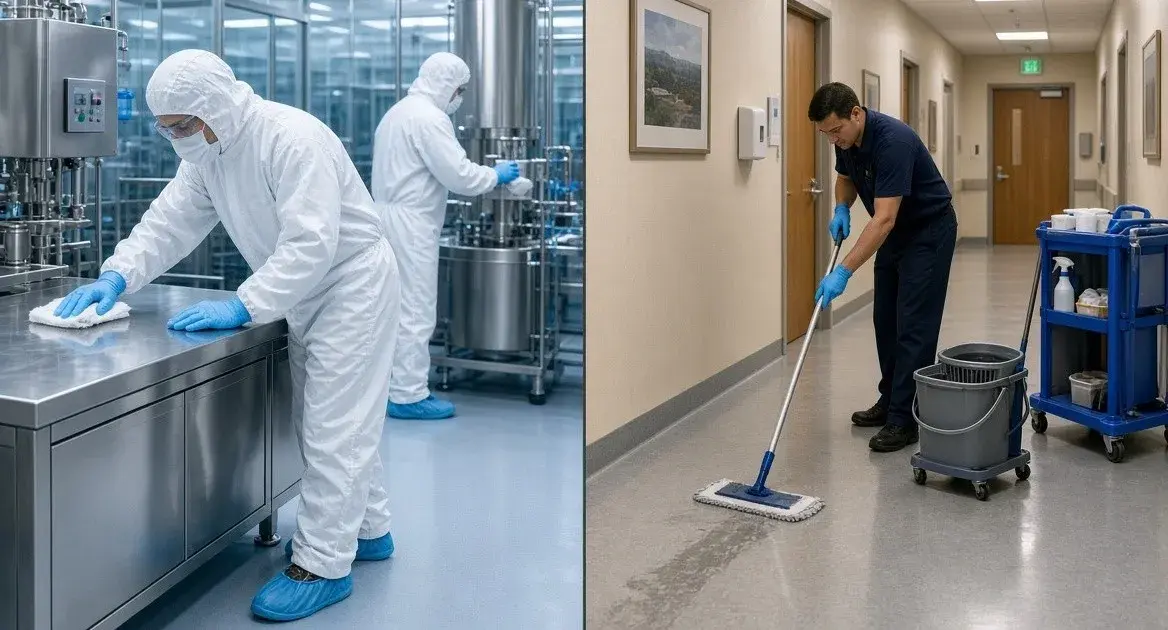
This is not a vendor preference argument. It is a regulatory reality. FDA 21 CFR Part 211 treats cleanroom cleaning as part of the manufacturing process. ISO 14644-1 ties your cleanroom classification — and everything that depends on it — to a cleaning program that can be validated and demonstrated. USP <797> embeds cleaning frequency and documentation directly into its compliance framework. None of these standards have a carve-out for facilities that chose their cleaning vendor based on commercial cleaning experience.
What Actually Separates GMP Cleanroom Cleaning from Janitorial Work
The distinction is not about effort or intention. A janitorial crew can work hard, use good products, and leave a space visually clean. None of that satisfies GMP requirements. Here is where the frameworks diverge:
Regulatory governance
Janitorial cleaning is governed by nothing beyond basic occupational safety requirements and the client's own preferences. GMP cleanroom cleaning is governed by written regulations and guidance documents — FDA 21 CFR Part 211, ISO 14644-1 and -2, USP <797> and <800> for sterile compounding, EU GMP Annex 1 for sterile pharmaceutical manufacturing, and in some facilities ISO 13485 for medical device quality systems. The cleaning program must be designed to satisfy these standards, and the vendor performing the work must understand and operate within them.
Personnel qualification
A janitorial technician requires no formal qualification beyond basic onboarding. A GMP cleanroom cleaning technician must be trained in aseptic technique, qualified through observed competency assessments on each procedure they perform, trained in gowning for each ISO classification zone they enter, and documented as qualified in retrievable training records. The training program itself must be designed to produce a consistently qualified technician — not just a person who has read the procedure once.
Tools and materials
Commercial cleaning uses readily available products: string mops, cotton rags, multi-surface sprays, general-purpose disinfectants. These are inappropriate — and in many cases prohibited — in classified cleanrooms. GMP cleanroom cleaning requires low-lint polyester or cleanroom-grade microfiber wipers (sterile, single-use in ISO 5 zones), EPA-registered disinfectants validated for efficacy on specific surfaces, non-shedding aluminum or stainless mop systems with validated laundering programs, and cleaning solutions prepared at documented concentrations. The tools themselves are a contamination variable that must be controlled.
Disinfectant program
A janitorial contractor uses whatever disinfectant is in their supply room, applied according to label directions, with no documentation of contact time or efficacy against specific organisms. A GMP cleanroom cleaning program uses a validated rotation of EPA-registered agents — typically a quaternary ammonium compound, 70% IPA, and a periodic sporicidal such as bleach, peracetic acid, or hydrogen peroxide vapor. Each agent is selected for its mechanism of action against the organism spectrum relevant to the classified space. Rotation is not a preference; it is a GMP requirement to prevent selective proliferation of resistant organisms.
Documentation
Janitorial cleaning produces, at most, a sign-in sheet. GMP cleanroom cleaning produces contemporaneous batch records for every cleaning event — identifying the operator, the products used with lot numbers, the procedures followed, the time of execution, and a supervisor sign-off. These records are retained per the site's data retention policy and must be available for regulatory review. An auditor who asks to see cleaning records and receives a sign-in sheet has found a 483 observation.
nanoCLEAN's technicians are GMP-trained, gowning-qualified, and supported by GDP-compliant documentation — the standard a regulated facility requires from its cleaning partner.
Talk to a GMP Cleaning SpecialistWhere Facilities Get Into Trouble
The pattern is consistent across the facilities that have learned this lesson the hard way. A janitorial vendor — sometimes the building's existing service provider — is brought in to clean the cleanroom as a cost-saving measure or a stopgap during a staffing gap. The vendor uses their standard products and procedures. The space looks clean. Nobody raises a concern until an FDA investigator arrives and asks to see the cleaning SOPs, the batch records, the disinfectant validation data, and the technician training records.
What follows is a 483 observation citing inadequate cleaning procedures, unqualified cleaning personnel, and missing documentation — and a CAPA that is significantly more expensive than the cost savings from the original vendor decision.
The scenario does not require malicious intent. The janitorial contractor is doing exactly what they were hired to do. The compliance failure belongs to the facility that made the hiring decision without understanding what GMP cleaning actually requires.
The same risk applies to internal staff reassigned to cleanroom cleaning without proper GMP training. A maintenance technician or facilities employee with no aseptic technique training, no gowning qualification, and no GDP documentation habits is not a GMP cleaning technician — regardless of how capable they may be in other functions. For more on the documentation obligations that separate a compliant cleaning program from cleaning activity, see our post on GMP vs GDP in cleanroom cleaning.
What a Qualified Cleanroom Cleaning Program Actually Looks Like
A GMP-compliant cleanroom cleaning program has five identifiable components — any vendor or internal program that cannot demonstrate all five should not be cleaning your classified space:
Validated, written SOPs for each type of clean performed, each ISO classification zone, and each non-routine cleaning event (post-maintenance, post-contamination, pre-campaign). These are controlled documents, version-managed, and reviewed on a defined schedule.
Qualified personnel with documented training records covering aseptic technique, gowning competency (with observed assessment), procedure qualification, GDP, and chemical handling. Records are current, retrievable, and cover every individual who has ever cleaned your cleanroom.
Validated disinfectant rotation using EPA-registered agents with documented kill claims appropriate to your ISO classification and organism risk profile. Rotation schedule is defined in the SOP, not ad hoc.
Appropriate tools — low-lint, non-shedding, classification-appropriate wipers and mop systems — inventoried, cleaned, and replaced on a documented schedule.
Contemporaneous batch records for every cleaning event, completed at the time of cleaning, retained per the site's data retention policy, and available for regulatory review within a defined response window.
If your current cleaning program — whether internal or contracted — cannot produce all five on request, you have a gap worth closing before your next inspection. For a structured framework to evaluate a prospective cleaning vendor against these criteria, see our post on how to evaluate a cleanroom cleaning vendor.
Not sure whether your cleaning program would hold up to a regulatory review? nanoCLEAN offers cleaning program assessments for regulated facilities across New England — identifying documentation gaps, SOP deficiencies, and training weaknesses before your auditor does.
Talk to a GMP Cleaning SpecialistFrequently Asked Questions
What makes cleanroom cleaning different from regular commercial cleaning?
Cleanroom cleaning is a regulated, validated discipline governed by GMP requirements such as FDA 21 CFR Part 211 and ISO 14644-1. Unlike commercial cleaning, it requires EPA-registered disinfectants applied at validated concentrations with documented contact times, single-use or validated-reusable tools that do not shed particles, personnel trained and qualified in aseptic technique and gowning, and contemporaneous batch records for every cleaning event. The purpose is not visual cleanliness — it is measurable reduction of viable and non-viable contamination to levels that protect product integrity and patient safety.
Can a janitorial company clean a pharmaceutical cleanroom?
Not without significant risk to your compliance program. A janitorial company will not have validated SOPs for classified environments, will not maintain GDP-compliant cleaning records, and will not have technicians qualified in GMP aseptic technique or ISO-appropriate gowning. Allowing an unqualified vendor into your cleanroom creates a direct audit finding risk — and more importantly, a contamination risk to your product. Cleanroom cleaning requires a vendor whose core competency is GMP compliance, not building maintenance.
What qualifications should cleanroom cleaning personnel have?
Cleanroom cleaning technicians must be trained and documented-qualified in aseptic technique and contamination control principles; gowning procedures appropriate to each ISO classification zone, verified through observed competency assessments; written SOPs for each procedure they are authorized to perform; Good Documentation Practices; and chemical handling including disinfectant dilution and contact time requirements. Training records must be maintained in retrievable format and available for regulatory review.
Why does cleanroom cleaning require documented SOPs?
FDA 21 CFR Part 211 requires written procedures for all cleaning and sanitation of manufacturing equipment and facilities. In a GMP context, a procedure that is not written does not exist from a regulatory standpoint. SOPs define exactly what is cleaned, in what sequence, with which products at what concentrations and contact times, using which tools, and by personnel with which qualifications. They are the foundation of a defensible cleaning program.
What happens if a facility uses an unqualified cleaning vendor in a GMP area?
Using an unqualified cleaning vendor in a GMP cleanroom exposes the facility to regulatory and quality risk. FDA 21 CFR Part 211 requires that personnel involved in manufacturing — including cleaning — be trained and supervised. An unqualified vendor without validated SOPs, GDP documentation, or GMP-trained technicians creates a citable deficiency. Improper technique, wrong disinfectants, or inadequate contact time can directly cause environmental monitoring excursions and product contamination. The cost of a contamination event remediation far exceeds any cost savings from using a lower-qualified vendor.